
What does age on another planet mean?
A planetary year is one orbit around the Sun. Mercury completes an orbit in about 88 Earth days, while Neptune needs about 60,189 Earth days. The same elapsed time therefore contains many Mercury years but only a fraction of a Neptune year.
The solar day result is a separate count. It measures complete day and night cycles using the selected planet's solar day. It does not claim that a person could live on that planet.
How long is a year on each planet?
If the table is wider than your screen, scroll across to compare the year and solar-day columns. Keyboard users can focus the table region and use the arrow keys.
| Planet | Orbital year in Earth days | Solar day in Earth days |
|---|---|---|
| Mercury | 87.969 | 175.942 |
| Venus | 224.701 | 116.750 |
| Earth | 365.2425 | 1 |
| Mars | 686.980 | 1.027491 |
| Jupiter | 4,332.589 | 0.413540 |
| Saturn | 10,759.22 | 0.444010 |
| Uranus | 30,685.4 | 0.718330 |
| Neptune | 60,189 | 0.671250 |
NASA describes the solar system as eight planets: Mercury, Venus, Earth, Mars, Jupiter, Saturn, Uranus and Neptune. Its planetary comparison data provides the orbital and rotation basis used here. See NASA's planet overview and planetary comparison table.
How the calculator works
The calculator counts fully elapsed Earth days from the birth date to today, then divides that total by each planet's orbital period. The detailed result uses the planet you choose. Its next planetary birthday is the next whole multiple of that orbital period, rounded to the nearest Earth day to give a usable calendar date.
Use a home planet in LifeDates
The LifeDates iPhone app includes the same eight planet choices in Settings under Home Planet. Your selected orbital year can then flow through exact ages, birthday countdowns, milestones, reminders, widgets and share cards. Earth remains the standard choice.
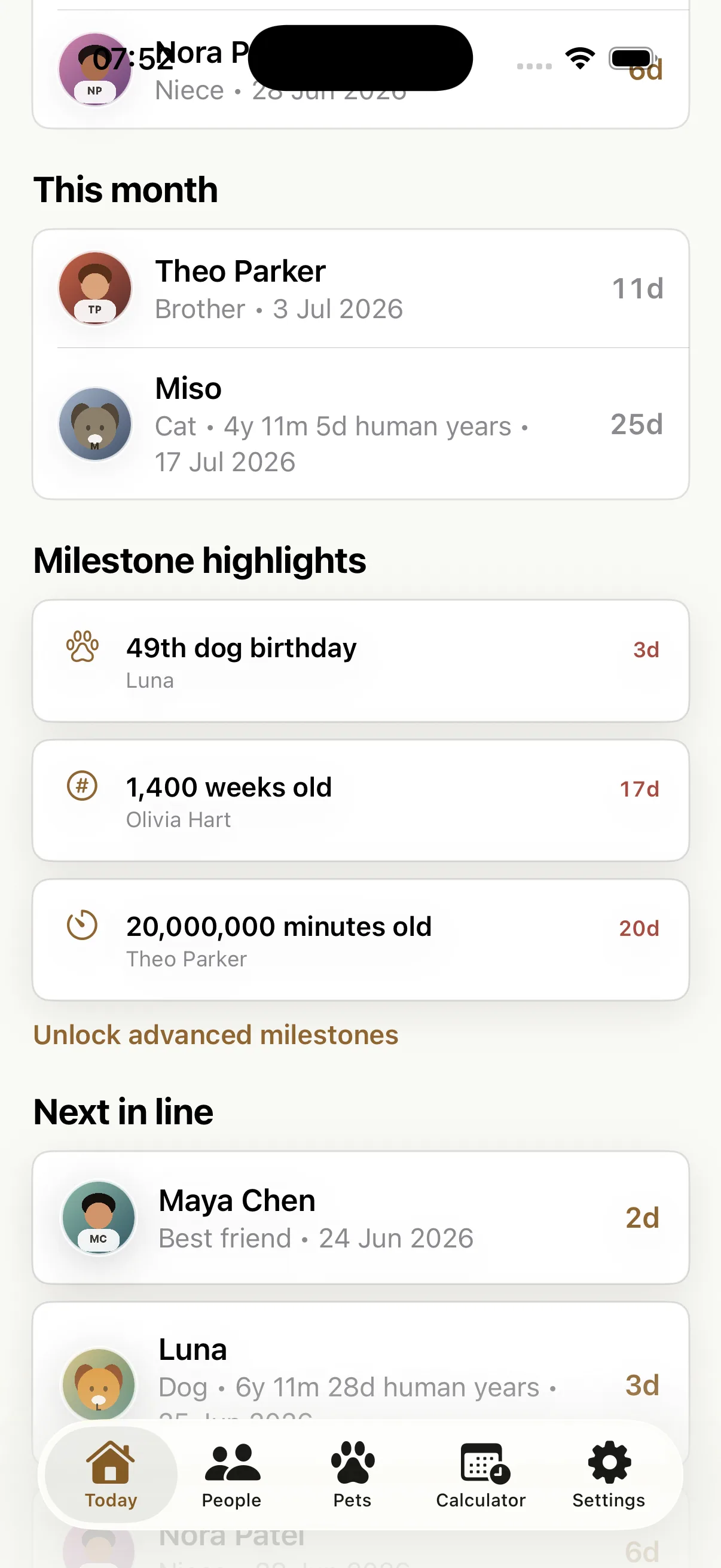
Put another planet on your timeline.
Download LifeDates and choose your Home Planet in Settings.
Download on theApp Store